Quiet courage
Nobody solves a problem with magic or force. Stopping, sitting, listening and paying close attention turn out to be the brave thing to do.
From The Lantern Map picture books
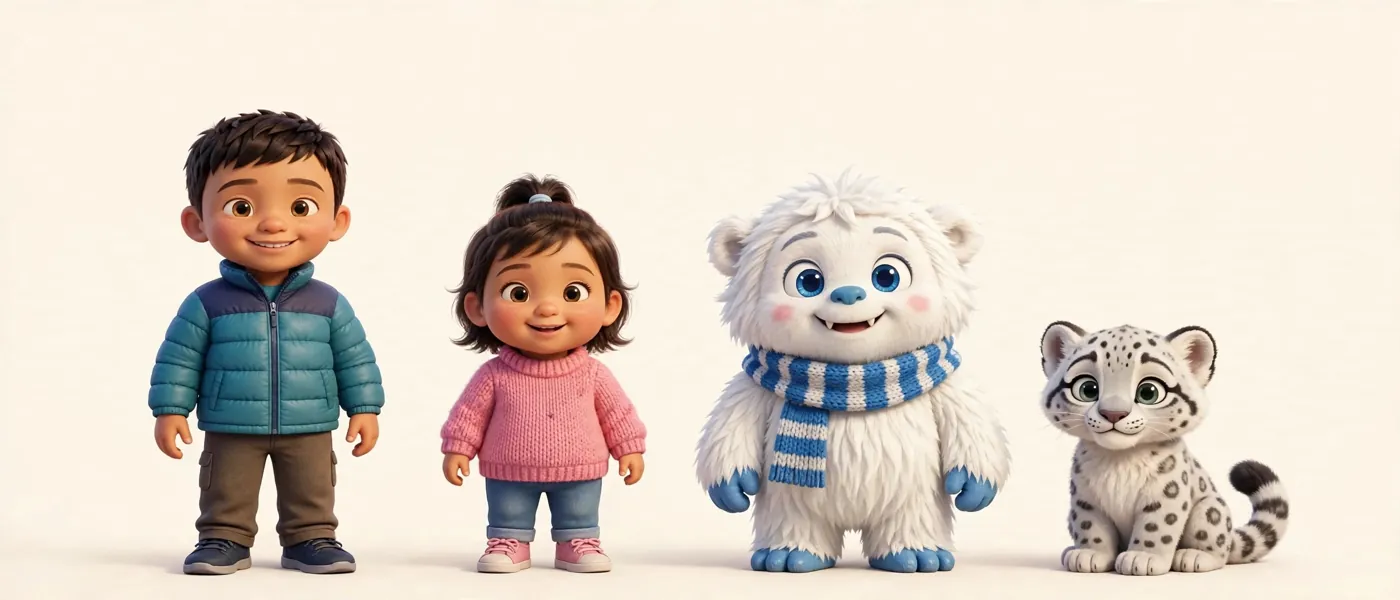
I'm a little white yeti with a stripy scarf. Every night, Alex, Kristina and I open an old atlas under the bed and go somewhere new. We're always home before the lights go out.
Three travellers
Slide to how tall you are.
 Kristina90 cm
 Alex110 cm
You're taller than Kuhiro!
Turn the crank four times. Click, click, click, click!
Tap every word to light it up, or tap “Read it to me”.
The Lantern Map
Spin the world. Tap a glowing light.
Games
For parents and grown-ups
Follow Kuhiro, Alex and Kristina through hidden wonders, new friendships and the question that leads all the way home. A ten-book picture-book series for ages 3 to 7 by A. K. Dhakal, published by Story Jar Press.
Why The Lantern Map
Nobody solves a problem with magic or force. Stopping, sitting, listening and paying close attention turn out to be the brave thing to do.
Every destination is a real place with its real animals, words and customs. Local children know their own homes and lead the way. The visitors never arrive to save the day.
Across 28 scenes, the lantern winding, the rhyming lantern words and the goodbye "Bye, Kuhiro" come round again and again, so children start saying them with you.
Each book solves one local child's problem and ends properly at bedtime. Underneath, one question keeps growing: where does Kuhiro come from, and who gave him his name?
The picture books for ages 3 to 7 are the heart of it. A chapter-book line for ages 6 to 8 and an animated series for ages 4 to 7 are in development.
Every book, every night
It's a simple rule with a lasting idea: friendship grows through listening, giving and sharing.
Follow the route
From the first fog in Nepal to the last blank page in Antarctica.
The story behind the stories
Every book stands on its own. Underneath runs a ten-book mystery, and Alex becomes the reader's detective. Why does Kuhiro know local customs before they arrive? Why does his scarf get lumpier with keepsakes? And why do children around the world know his full name before anyone says it?
In every country the local child brings the knowledge and leads the answer. Alex, Kristina and Kuhiro learn to watch, listen and follow local customs, like walking clockwise around a stupa in Nepal or leaving the middle of the path free at a shrine in Japan.
dhanyabaditadakimasuhvalaobrigadotakkkadrin cheẹ ṣégraciaske a leboga
Kristina says the lantern words, notices the tiny things everyone else misses and leads the tender moments. Alex grows a little each time, from finding stillness in Japan to facing his fear of endings beside a river in Botswana. Kuhiro needs looking after too. He hates heat, blows on hot tea until it's cold, and never pretends to know everything.
Each book has its own trail of sounds for reading aloud:
tonkdingclack-clackplinktaptingfrrrrlap-lapcrunch
The pictures hide something to find, too: a snow leopard cub in Nepal, 28 paper cranes in Japan, and a different hidden object in every book.
Inside Book One
The lantern crank, the travel lines, and the first time the familiar words fail, when Kristina tries to find Kuhiro in the fog.
Pema teaches Alex that running in fog leads off cliffs, and that stopping and listening can be the brave choice. Alex lets Kuhiro decide for himself whether to stay.
From the warm colours of a Kathmandu market to cold mountain blue to pure white fog, with a snow leopard hiding throughout.
Walking clockwise around a stupa, prayer flags, dudh chiya, the difference between a yak and a nak, and the local names Chomolungma and Sagarmatha.
Kuhiro reads Nepali signs, blows on his tea until it's cold, and Pema says "Bye, Kuhiro" though nobody told her his name.
Each adventure hides a tiny clue in the pictures. The first book's trail belongs to the snow leopard.
Look for the snow leopard cub on the spreads in Nepal. It's hiding on pages you might not expect, so look slowly.
The lantern never has a flame. It winds up with a crank and glows by itself. Whenever the children are somewhere risky, a caring grown-up is right there with them, so children feel the adventure while grown-ups feel the safety.
Kuhiro is said KOO-hee-ro, with the stress on the first part. It's the Nepali word for fog, कुहिरो. His friends call him Hiro. Only Kristina calls him Ku.
Books six to ten are being written now. Each country's story is read by people from that country before it's finished.
Keep the lantern close
Launch news and new-book announcements only. For grown-ups.
MeetKuhiro.com has no ads and nothing for children to sign up for. It doesn't collect anything from children, and it uses no tracking cookies. The story jar is remembered only in this browser, on this device. Any link that leaves the site asks a grown-up first.
Questions or school visits:
Kuhiro, Alex, Kristina, The Lantern Map and everything on this site, including the stories, pictures, voices, music and code, are © 2026 A. K. Dhakal / Story Jar Press. All rights reserved.
Families and classrooms are welcome to print the Kuhiro colouring page for their own use. Copying, sharing, selling or adapting the characters, art, audio or text in any other way needs written permission from Story Jar Press first.
© 2026 A. K. Dhakal · Story Jar Press, San Francisco. All rights reserved.
This link leaves MeetKuhiro.com. Grown-ups, press and hold the lantern for two seconds to continue.